
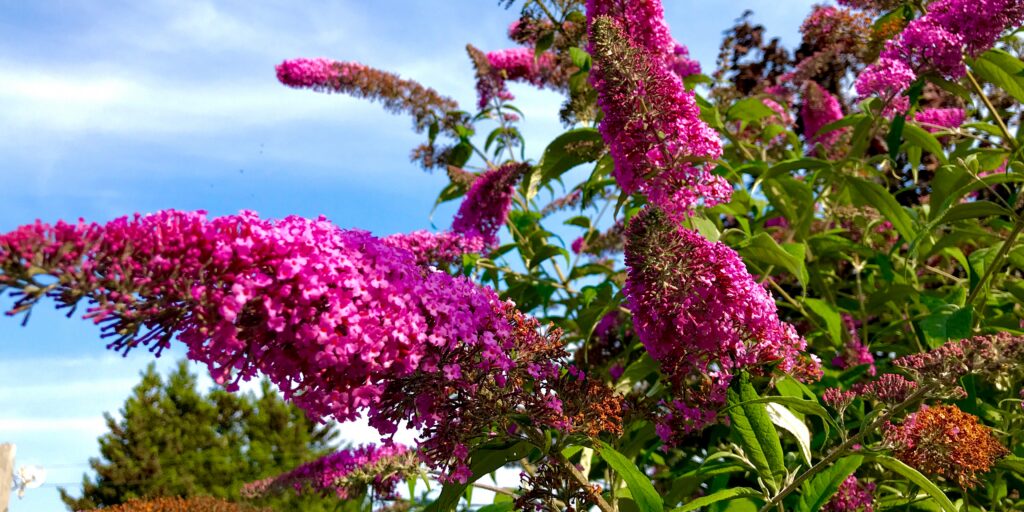
Buddleia is one of the most popular flowering shrubs for sunny gardens. During summer, it produces long clusters made up of hundreds of small, often fragrant flowers. These blooms attract butterflies, bees and other pollinating insects, which is why the plant is widely known as the butterfly bush.
The most commonly grown species is Buddleja davidii. Gardeners can choose from varieties with purple, blue, pink, white, magenta or deep reddish flowers. Cultivars also vary in height, spread, leaf color and flower size.
Traditional butterfly bushes may grow several meters tall and wide, while compact cultivars are suitable for small gardens, patios and containers. Whatever the variety, successful buddleia care depends on generous sunlight, well-drained soil, appropriate watering and correct pruning.
Buddleja davidii flowers on new growth produced during the current season. A strong spring prune encourages vigorous shoots and abundant flower clusters. Without pruning, the shrub may become tall, open and bare at the base, with most flowers appearing well above eye level.

What Is Buddleia?
Buddleia is a genus containing shrubs and small trees native to parts of Asia, Africa and the Americas. Many garden species are deciduous, although their behavior can vary according to climate.
Buddleja davidii develops long, arching stems. Its leaves are narrow and usually paler or slightly felted underneath.
The flowers are arranged in cone-shaped clusters. Individual blooms are small, but the complete flower spike can be long and highly decorative.
Most varieties bloom from summer into early autumn. Regular removal of spent flower clusters may encourage smaller side shoots to continue flowering.
The plant is known for fast growth. After a hard spring prune, healthy stems may extend by more than a meter during one growing season.
Popular Types of Buddleia
Buddleja davidii is the best-known butterfly bush. It flowers on new wood and responds well to hard pruning in spring.
Buddleja alternifolia, commonly known as alternate-leaved butterfly bush, has graceful arching branches. Small purple flowers develop along stems produced during the previous season. It must therefore be pruned after flowering rather than cut hard in early spring.
Buddleja globosa produces distinctive round clusters of orange or golden-orange flowers. It generally prefers warmer and more sheltered conditions.
Modern hybrids may offer compact growth, unusual flower colors, longer flowering or reduced seed production. Dwarf cultivars have made it possible to grow butterfly bush in large patio containers.
Always check the botanical name and cultivar label before buying. The exact identity affects mature size, pruning method and winter hardiness.
How to Choose the Right Buddleia
Consider the available space before selecting a plant. A traditional Buddleja davidii may eventually reach two or three meters in height and develop a similar spread.
Compact cultivars are more suitable for small borders, front gardens and pots. Many remain around one to one and a half meters tall when regularly pruned.
When buying a buddleia, look for:
- healthy leaves,
- firm stems,
- active young buds,
- a root ball without a sour smell,
- no visible aphids or spider mites,
- a clear species and cultivar label,
- information about mature size,
- confirmation that the variety suits container growing if required.
A very large nursery plant is not always the best choice. A smaller, well-rooted specimen can establish quickly and develop into a stronger shrub.
The Best Position for Buddleia
Buddleia performs best in full sun. It should receive at least six hours of direct sunlight each day for strong growth and generous flowering.
A plant grown in partial shade may survive, but it is likely to produce weaker stems and fewer flowers. Deep shade is unsuitable.
Choose a position protected from severe wind. Young stems are flexible, but strong storms can bend or snap them. Winter winds may also dry and damage the upper branches.
Suitable locations include:
- a sunny perennial border,
- a position near a terrace,
- a south-facing wall,
- a mixed shrub border,
- a butterfly garden,
- a free-standing lawn feature,
- a large patio container.
Allow room for the arching branches to spread. A plant positioned too close to a path may obstruct access during summer.
The Best Soil for Buddleia
Buddleia grows best in moderately fertile, well-drained soil. Established plants can tolerate relatively poor ground, but they dislike prolonged waterlogging.
Heavy clay should be improved with mature compost and materials that increase soil structure. Do not rely only on a layer of gravel at the bottom of the planting hole. Improving a broader area is more effective.
Very sandy soil dries quickly. Organic matter helps it retain moisture and nutrients.
Buddleia generally tolerates slightly acidic, neutral and mildly alkaline conditions. Good drainage is usually more important than an exact soil pH.
Avoid low areas where rainwater collects. In a wet garden, planting on a raised bed or gentle slope may reduce the risk of root rot.
When to Plant Buddleia
Spring is usually the best planting time, particularly in colder regions. The shrub then has an entire growing season to establish before winter.
Early autumn planting can also work in mild areas. The soil remains warm, and natural rainfall can support root growth.
Container-grown plants may be planted during most of the growing season as long as the ground is not frozen, saturated or extremely dry.
Avoid planting during intense summer heat whenever possible. If summer planting is necessary, provide regular deep watering and temporary protection from the hottest afternoon sun.

How to Plant Buddleia Correctly
Water the root ball thoroughly before planting. A very dry root ball can be soaked briefly in a bucket of water.
Dig a hole approximately twice as wide as the nursery pot but no significantly deeper. Plant the shrub at roughly the same depth at which it was growing in its container.
A reliable planting method includes:
- removing perennial weeds,
- loosening the surrounding soil,
- digging a broad hole,
- mixing mature compost with the original soil,
- carefully removing the plant from its pot,
- loosening tightly circling roots,
- positioning the root ball,
- backfilling with soil,
- gently firming the surface,
- watering deeply,
- adding organic mulch.
Keep mulch away from direct contact with the base of the stems. Constant moisture against the crown can encourage decay.
Spacing Buddleia Plants
Spacing depends on the mature width of the cultivar. Large butterfly bushes may need approximately one and a half to two meters between plants.
Compact varieties can be planted closer together, but always follow the expected dimensions provided on the label.
Crowded planting can cause:
- poor air circulation,
- reduced sunlight,
- fewer flowers,
- increased disease risk,
- competition for water,
- difficulty during pruning,
- tangled branches.
Avoid planting buddleia immediately beside another vigorous shrub. Both plants need space for roots and top growth.
Watering Buddleia
A newly planted buddleia needs regular watering while its roots become established. During the first growing season, do not allow the root ball to dry completely.
Water deeply rather than applying a small amount every day. Deep watering encourages the root system to move into the surrounding soil.
Once established, butterfly bush can tolerate short dry periods. Additional water is still valuable during extended summer heat and drought.
Water is especially important:
- immediately after planting,
- during rapid spring growth,
- while flower buds are developing,
- during prolonged hot weather,
- after transplanting,
- for plants growing in containers.
Direct water toward the root area. Constantly wet flowers may brown more quickly, and damp foliage can encourage disease.
Feeding Buddleia
Buddleia does not require heavy feeding. In reasonably fertile soil, an annual spring application of mature compost may be enough.
A balanced slow-release fertilizer for flowering shrubs can be used in poor soil. Follow the product instructions and avoid excessive quantities.
Too much nitrogen produces long, soft stems and abundant leaves. Flowering may be reduced, and the weak stems can be more vulnerable to wind and frost.
Container plants need more regular feeding because nutrients are gradually washed from the potting mix. Use a moderate dose during active growth.
Stop high-nitrogen feeding by late summer. New stems need time to mature before winter.
Why Pruning Is Important
Regular pruning keeps buddleia compact and encourages strong flowering shoots. Buddleja davidii produces its flowers on new growth.
Without pruning, the shrub becomes tall and open. The lower framework may become bare, while the flowers develop high above the ground.
Correct pruning helps to:
- remove winter damage,
- control mature size,
- encourage branching,
- produce more flowering stems,
- improve air circulation,
- maintain an attractive shape,
- rejuvenate an old shrub.
Pruning advice must match the species. Buddleja alternifolia should not be treated in the same way as Buddleja davidii.
When to Prune Buddleja davidii
Carry out the main prune in spring, after the danger of severe frost has passed. New buds are often beginning to swell at this stage.
Pruning too early may expose fresh growth to frost. Pruning very late can delay flowering.
In warmer regions, the shrub may be cut earlier. In colder areas, wait until it is clear which branches survived winter.
Avoid a hard autumn prune. The old top growth provides some protection to the base and can trap insulating snow.
Exceptionally long branches may be shortened in autumn if they are likely to break in winter wind. Save the main pruning for spring.
How to Prune Buddleja davidii
Begin by removing dead, broken and diseased stems. Then shorten the healthy framework.
A strong established shrub can often be cut back to approximately thirty to fifty centimeters above the ground. Leave several healthy buds on each main stem.
Use clean, sharp secateurs. Thick stems may require a pruning saw. Make each cut slightly above a healthy bud.
Remove branches that:
- cross one another,
- grow into the center,
- lie on the soil,
- are weak and thin,
- have been damaged by frost,
- spoil the overall shape.
An old neglected shrub can be renovated with a harder prune. If the plant is weak, spread major renovation over two seasons.
How to Prune Buddleja alternifolia
Buddleja alternifolia flowers on shoots formed during the previous year. Hard spring pruning would remove the stems carrying future flowers.
Prune this species after flowering. Remove some of the oldest branches and leave healthy young growth for the following season.
Maintain its natural arching shape. Excessive shortening can destroy the graceful structure.
Checking the botanical name before pruning is essential. Incorrect timing is a common reason for a butterfly bush failing to flower.
Removing Spent Flowers
Spent flower spikes can be removed throughout summer. Deadheading prevents the shrub from using as much energy to produce seed and may encourage more side flowers.
Cut each fading cluster above a healthy pair of leaves or a side shoot.
Deadheading helps to:
- extend the flowering season,
- maintain a tidy appearance,
- reduce self-seeding,
- encourage lateral growth,
- remove dry flower material.
Leave flowers until pollinators have finished using them, but remove the clusters before seeds mature if uncontrolled spreading is a concern.
Why Buddleia Does Not Flower
A lack of flowers is often connected with insufficient sunlight, incorrect pruning or excessive nitrogen.
Common causes include:
- a shaded position,
- pruning at the wrong time,
- overfeeding,
- frost damage,
- waterlogged soil,
- prolonged drought,
- damaged roots,
- an overcrowded shrub,
- a very young plant,
- a species unsuited to the local climate.
Buddleja davidii needs spring pruning, while Buddleja alternifolia should be pruned after flowering. Confusing the two methods can remove flowering wood.
A plant that produces many long green stems but few blooms may be receiving too much nitrogen or too little direct sun.
Growing Buddleia in a Container
Compact buddleia cultivars can be grown successfully in large pots. The container must be stable and have generous drainage holes.
Use a high-quality, well-drained potting mix. Never allow the roots to remain in standing water inside an outer decorative pot.
Container-grown buddleia needs:
- full sun,
- frequent moisture checks,
- moderate feeding,
- annual pruning,
- winter root protection,
- occasional repotting,
- shelter from strong wind.
Potting mix dries much more quickly than garden soil. During hot weather, check the container every day.
A heavy pot is safer than a lightweight one because a tall flowering shrub can become unstable in wind.
Repotting Container Buddleia
Repot when roots fill the entire container, the growing mix dries almost immediately or the plant stops growing well.
Choose a new pot only slightly larger than the old one. An oversized container holds a large amount of wet compost and may increase the risk of root rot.
Spring is the best time to repot. Water thoroughly afterward and protect the plant temporarily from severe sun and wind.
For very large containers, replace the upper layer of compost each spring. Complete repotting or careful root pruning may still be needed after several years.
Winter Protection
Hardiness depends on species, cultivar, plant age and climate. Established Buddleja davidii plants usually tolerate normal winters, although the upper stems may be damaged.
The root system is often hardier than the top growth. A shrub that appears dead may produce new shoots from the base in spring.
Apply a layer of compost, dry leaves or organic mulch around the root zone in autumn. This helps moderate temperature changes.
Young plants can be protected with breathable horticultural fabric. Do not wrap the stems tightly in airtight plastic.
Container plants require more protection. Insulate the pot, place it on a wooden base and move it close to a sheltered wall.
Propagating Buddleia From Cuttings
Buddleia is relatively easy to propagate from cuttings. Soft summer shoots or semi-ripe stems can be used.
Choose a healthy non-flowering shoot. Cut a section with several pairs of leaves. Remove the lower leaves and reduce very large upper leaves.
Insert the cutting into a light mixture of propagation compost and perlite.
Successful rooting requires:
- lightly moist compost,
- bright indirect light,
- stable warmth,
- protection from direct sun,
- gentle humidity,
- regular ventilation,
- clean pots and tools.
Once roots form, pot the young plant separately. Protect it from severe frost during its first winter.
Growing Buddleia From Seed
Buddleia can be raised from seed, but seedlings may not match the parent cultivar. Flower color, plant size and growth habit can vary.
The seeds are very small. Sow them on the surface of fine compost and press them down lightly. Do not bury them deeply.
Seed raising is useful for experimentation and botanical species. Cuttings are more reliable when a particular named cultivar must be preserved.
Self-seeding can be abundant. Seedlings may appear in gravel, wall cracks and dry corners of the garden.
Remove unwanted plants while they are young. Older seedlings develop a stronger root system and become more difficult to remove.
Buddleia Pests
Buddleia is generally robust, but it may be attacked by aphids, spider mites, whiteflies, thrips and caterpillars.
Aphids gather on young shoots. They distort leaves and produce sticky honeydew.
Spider mites become common during hot, dry weather. The leaves develop fine pale speckling, and severe infestations create webbing.
Whiteflies are more likely on container plants kept in protected spaces. Small white adults fly from the leaves when disturbed.
Caterpillars create irregular holes. A small number can be removed by hand.
Use pesticides cautiously while the plant is flowering. Buddleia is frequently visited by bees, butterflies and other beneficial insects.
Buddleia Diseases
Most serious problems are connected with poor drainage, crowded growth or unsuitable conditions.
Root rot develops in waterlogged soil. The plant wilts and yellows even though the ground remains wet.
Powdery mildew produces a white coating on leaves. Better airflow, correct spacing and consistent root moisture can reduce the risk.
Leaf spots may develop during prolonged damp weather. Remove affected leaves and do not leave them beneath the shrub.
Good prevention includes:
- a sunny position,
- well-drained soil,
- sufficient spacing,
- watering at the roots,
- clean pruning tools,
- removal of infected material,
- balanced feeding.
Use fungicides only after the problem has been identified correctly.
Why Buddleia Leaves Turn Yellow
Yellowing in autumn is normal because most buddleias are deciduous. Yellow leaves during active growth may indicate stress.
Possible causes include:
- overwatering,
- prolonged drought,
- damaged roots,
- nutrient deficiency,
- excessive fertilizer,
- unsuitable soil pH,
- spider mites,
- transplant shock,
- natural aging of lower leaves.
Check soil moisture before adding water or fertilizer. A wet root ball combined with wilting leaves may indicate root rot.
Yellow tissue between green veins may be connected with nutrient availability. Assess soil pH and root health before applying supplements.
Buddleia and Pollinators
Buddleia flowers provide nectar for butterflies, bees and other insects during summer. This makes the shrub a valuable seasonal food source.
A pollinator-friendly garden should contain more than one flowering species. Combine buddleia with plants that bloom from spring to autumn.
Suitable companions include:
- lavender,
- catmint,
- salvia,
- echinacea,
- sedum,
- asters,
- oregano,
- thyme,
- yarrow,
- ornamental alliums,
- Russian sage.
Butterflies also need host plants for caterpillars, shallow water, shelter and areas managed without harmful insecticides.
Self-Seeding and Spread
Some buddleias produce large quantities of lightweight seed. Wind can carry it beyond the garden.
Removing spent flower spikes before seed maturity is the simplest way to reduce spreading.
Certain compact or low-fertility cultivars produce fewer viable seeds. Even so, the surrounding area should be monitored.
Young seedlings are easy to pull. Established plants develop tougher roots and require more effort to remove.
Do not place fully mature seed heads in a cool home compost pile if you want to prevent germination elsewhere.
Companion Plants for Buddleia
Buddleia creates a strong vertical feature and combines well with lower perennials and ornamental grasses.
Good companion plants include:
- lavender,
- coneflowers,
- black-eyed Susans,
- ornamental grasses,
- sedums,
- catmint,
- salvias,
- Russian sage,
- asters,
- roses,
- spring bulbs.
Lower plants can hide the woody base of an older butterfly bush. Leave enough space so the mature shrub does not shade them completely.
Choose companions that enjoy similar sunny, well-drained conditions.
A Seasonal Buddleia Care Calendar
In spring, inspect the shrub for winter damage. Prune Buddleja davidii, apply compost and plant new specimens once the soil is workable.
In late spring, monitor new growth and water during dry weather. Check soft shoots for aphids.
During summer, remove spent flower clusters and maintain moisture during heat. Inspect container plants frequently.
In late summer, reduce high-nitrogen feeding. Allow new stems to mature before winter.
In autumn, avoid hard pruning Buddleja davidii. Remove only dangerous or damaged branches and mulch young plants.
In winter, protect containers from freezing. Water lightly during prolonged dry, frost-free periods if the potting mix becomes completely dry.
Frequently Asked Questions About Buddleia
How Fast Does Buddleia Grow?
Buddleia grows very quickly. After spring pruning, new stems may extend by more than a meter during one season.
When Does Buddleia Flower?
Most Buddleja davidii cultivars flower from summer into early autumn. Timing depends on climate, cultivar and pruning date.
Is Buddleia Hardy?
Established Buddleja davidii plants are reasonably hardy, although stems may be damaged by frost. The root system often survives and produces new spring growth.
Should Buddleia Be Pruned Every Year?
Buddleja davidii benefits from annual spring pruning. Buddleja alternifolia should be pruned after flowering rather than cut hard in spring.
Can Buddleia Grow in Partial Shade?
It can survive in partial shade, but flowering is usually reduced. Full sun provides the best display.
Why Does Buddleia Look Dead After Winter?
The upper stems may have been killed by frost. Wait for spring growth and check whether the wood beneath the bark remains green.
Can Buddleia Be Grown on a Balcony?
Yes, especially compact cultivars. They need a large stable pot, full sun, regular watering and winter protection.
Should Spent Flowers Be Removed?
Deadheading is not essential for survival, but it extends flowering, improves appearance and reduces self-seeding.
Why Is Buddleia Wilting in Wet Soil?
The roots may be rotting. Waterlogged soil contains too little oxygen, preventing the root system from functioning normally.
How Can an Old Buddleia Be Rejuvenated?
Prune Buddleja davidii back to a strong healthy framework in spring. For a weak or severely neglected shrub, spread major renovation over more than one season.
Discover more plant-related articles and tips on our blog HERE.
Don’t forget to follow us on social media so you don’t miss any important news and updates HERE.